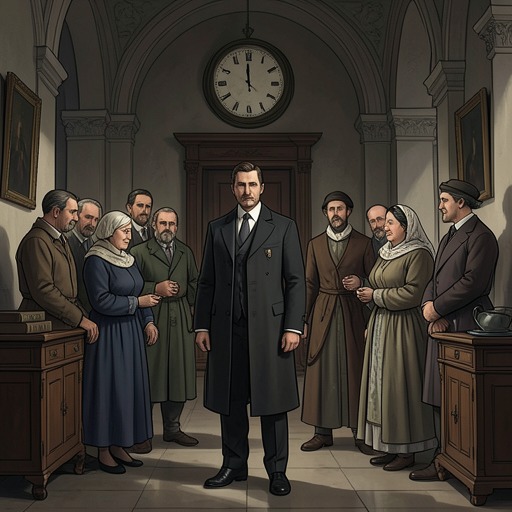
Elizabeth Mollineux
The Life and Opinions of Tristram Shandy, GentlemanElizabeth Mollineux, later known as Mrs. Shandy, is Tristram Shandy’s mother. Her role in the novel is shaped by two connected disputes: a marriage settlement that gives her a conditional right to give birth in London, and her insistence on choosing her own midwife rather than accepting Walter Shandy’s preferred medical attendant. Through these arrangements, the narrative places her decisions within a household where legal language, medical claims, and a husband’s authority all compete to determine the conditions of childbirth.
Identity and the Marriage Settlement
The marriage settlement anticipates a possible conflict between Elizabeth and Walter over where they will live after he leaves business. If he retires from London to his country estate while she remains capable of bearing children, the agreement requires him to provide £120 for each pregnancy. The money is intended to pay for a coach and horses to carry her to London and for the expenses of her confinement and lying-in there. It also gives her the right to choose where and with whom she will stay in the city, as though she were unmarried.
The provision is extensive in its legal form, but its practical force is narrowed by an additional clause. If Elizabeth sends Walter to London on what he claims are false signs of labour, she forfeits her right to the next turn, though not to all future turns. The narrator presents this as a safeguard against unfair use of the covenant, while also stressing that its burden falls upon him: his birth is tied to the dispute over whether his mother’s labour is real and whether she may exercise the settlement’s protection.
The Dispute over Her Confinement
In September 1717, the year before Tristram’s birth, Elizabeth takes Walter to London, much against his inclination. He invokes the clause, and the couple’s disagreement results in the decision that she will give birth in the country. Walter is characterized as persistent, and the narrator says Elizabeth understands that remonstrating with him is useless. Her contractual option, therefore, does not settle the matter: the scene turns on the difference between a right written into a marriage deed and the practical power to insist upon it within the marriage.
When Elizabeth is in labour, the household sends for the old midwife she has chosen. Walter also dispatches Obadiah to fetch Dr. Slop, a nearby man-midwife, and complains to Uncle Toby that Elizabeth is entrusting both her own life and the child’s to an old woman. Toby suggests that modesty may explain her choice. The episode makes Elizabeth’s preference a matter of debate among the men around her, but the decision itself remains hers: Walter’s opposition does not prevent the old midwife from being summoned.
Maternal Choice and Medical Authority
Elizabeth’s choice of attendant is not presented as a search for the most prestigious available practitioner. She has considered the midwife early in her pregnancy and settled on trusting her alone, despite the nearby availability of a trained male operator whose published work discusses midwifery and difficult births. The narrator emphasizes that the midwife has practiced in the parish for nearly twenty years without an accident fairly attributable to her. Her choice therefore rests, in the account given, on confidence in a practitioner with a substantial local record, even as the narrative treats the decision with characteristic irony.
Walter’s position combines concern for the risks of childbirth with a broader insistence on his own authority within the household. He argues in several roles—as husband, father, Christian, and patriot—while Elizabeth insists on her privilege to choose for herself. The narrator jokes that this is an uneven contest of many arguments against one, but also notes that personal chagrin helps her hold her ground. The outcome is a compromise: the old woman will attend Elizabeth, while Dr. Slop is permitted to drink wine with Walter and Uncle Toby and is paid five guineas.
Consequences for Tristram and the Narrative
Walter’s medical anxieties also arise from his theories about childbirth and intellectual development. After reading an account of the pressure exerted on a child’s head during delivery, he fears that ordinary birth may damage the brain and the supposed seat of understanding. He reasons that extraction by the feet would avoid the particular harm he imagines. These arguments help explain why the choice of attendant becomes more than a domestic preference: Walter treats the birth as a test of his theories, while Elizabeth’s decision concerns who will attend her.
The narrator connects the London covenant and its contested application to the injury to his nose at birth, describing himself as destined by the marriage articles to have it compressed. He promises to explain the later disappointments he associates with that injury, making his mother’s confinement part of a larger account of how small decisions and accidents shape a life. Elizabeth’s character is consequently conveyed less through independent narration than through the choices, legal provisions, and family arguments organized around her: she is a wife with a negotiated contractual protection and a mother who asserts her preference in the face of her husband’s objections.